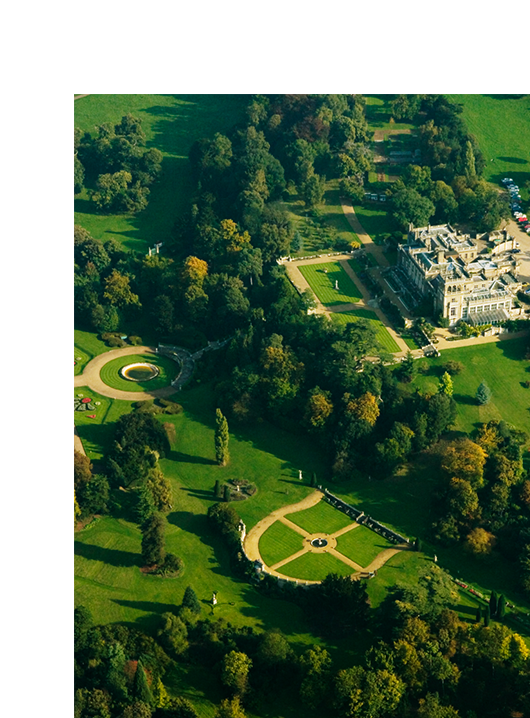

The Shrubland estate is thought to have originated with the building of the Old Hall by the Booth family in the early 16th Century. By the early 17th Century it had passed by marriage into the Bacon family and a map dated 1668 by Edward Clarke shows the lands of the Old Hall, of which a pond and a section of wall remain. In the 1770s John Bacon commissioned the architect James Paine (1717-89) to design a new hall on a new site. The new Georgian building still forms the core of the present hall and occupies a dramatic site at the top of a steep escarpment. Shrubland Palace is a fusion of three classic periods in English architecture: Palladian, Greek Revival and Italianate.
John Bacon passed in 1788, Shrubland Palace passing to his brother, Nicholas, who immediately sold the estate to Sir William Fowle Middleton (1748-1829), 1st Baronet, of Crowfield. Born in Charleston, South Carolina, where his family owned Middleton Place, he arrived in Suffolk after inheriting Crowfield Hall near Stowmarket. His brother, Henry, gave him £30,000 (some say this was won playing lottery and would be worth £6 million today) to spend on improvements at Shrubland Palace, and he employed Humphry Repton to expand the park from 1789 onwards, and replaced Paine wings in about 1808. Shrubland Hall was inherited by his only son, Sir William Fowle Middleton (1784-1860), 2nd Baronet, who brought in architect John Peter Gandy Deering in 1831-38, and later Alexander Roos between 1838-45, who enlarged and redecorated the house. In 1850, he turned to Sir Charles Barry who turned the property into an Italian palazzo with balustrades and a belvedere on the south-west tower.
Shrubland Palace boasts one of the grandest entrances to any English country house. The front doors open into a domed vestibule like a Renaissance chapel, with columned gallery on either side. Ahead is a grand staircase, a single straight flight inspired by the Scala Regia in the Vatican, with a shallow Grecian vault as exquisite as work by Sir John Soane in the Bank of England.
Shrubland passed in 1882 by marriage to the De Saumarez family, famous for its admirals. During World War One it was one of the first country mansions to be turned into a Red Cross Convalescent Hospital.